Profile
Stephen McDonnell is a landscape artist whose practice examines the relationship between natural and cultural landforms. His formal art education began as a teaching assistant under Frank Hewitt in the undergraduate painting and art history program at the University of Vermont, followed immediately by a graduate teaching assistantship at Oberlin College in Ohio. Through time experiencing these different landscapes, McDonnell became acutely aware of how different topographies shape perception and artistic form. These experiences expanded his understanding of “landscape” beyond traditional horizon or aerial perspective, toward a discipline in which land can be rendered without representation.
Rather than depicting or representing landscape, McDonnell increasingly employs natural materials as landscape. The earth materials he uses function not as symbols but as medium-- land itself-- continuing his early investigations into surface, flatness, and shaped canvas. After Oberlin and a brief period of teaching, McDonnell paused his formal art career while raising a family and pursuing other paths, though art’s influence remained integral to his way of seeing, imagining, designing and building.
He has since returned to painting and sculpture, reconnecting with earlier artistic associations while responding to resource extraction as ecocide. McDonnell’s current research-driven work addresses resource imperialism and extractivism, focusing on their environmental, social, economic, and health consequences. Growing up in a region of Pennsylvania scared by anthracite coal mining and its toxic legacy has primed him to recognize the parallel dangers caused by shale gas extraction through fracking. In this same region-- a hydrocarbon “sweet spot”—aquifers and air continue to receive radioactive and toxic waste, first from coal culm effluent and dust and now from fracking operations.
In his Extractivism series (DEATH SPIRAL and BONE ON BONE), McDonnell draws directly from Hewitt’s example of incorporating earth from his Vermont homestead into painting as a gesture honoring the dignity and fragility of nature. Placing dirt sourced from Hewitt’s Vermont homestead, silica frac sand from ~ Wisconsin, and black shale from the Marcellus formation in New York in deliberate tension, McDonnell exposes the obfuscation practiced by the extraction industry and its regulators-- systems that render consumers indifferent to the dangers of fracking but continue to attract investors. By contrasting the perceived purity of raw earth materials with those materials in service to the violence of industrial extraction, the work offers a visual critique of energy dominance in an era of climate crisis. Each piece is accompanied by informational “frac facts,” reinforcing McDonnell’s belief in art as a form of public education and awareness that can teach, warn and remember.
Using soil as a natural pigment arguably formed the basis of creative thought in society, most notably through cave paintings to tell stories in many parts of the world. McDonnell’s Extractivism pieces provide a contemporary borrowing from this tradition in their telling a story of resource imperialism.
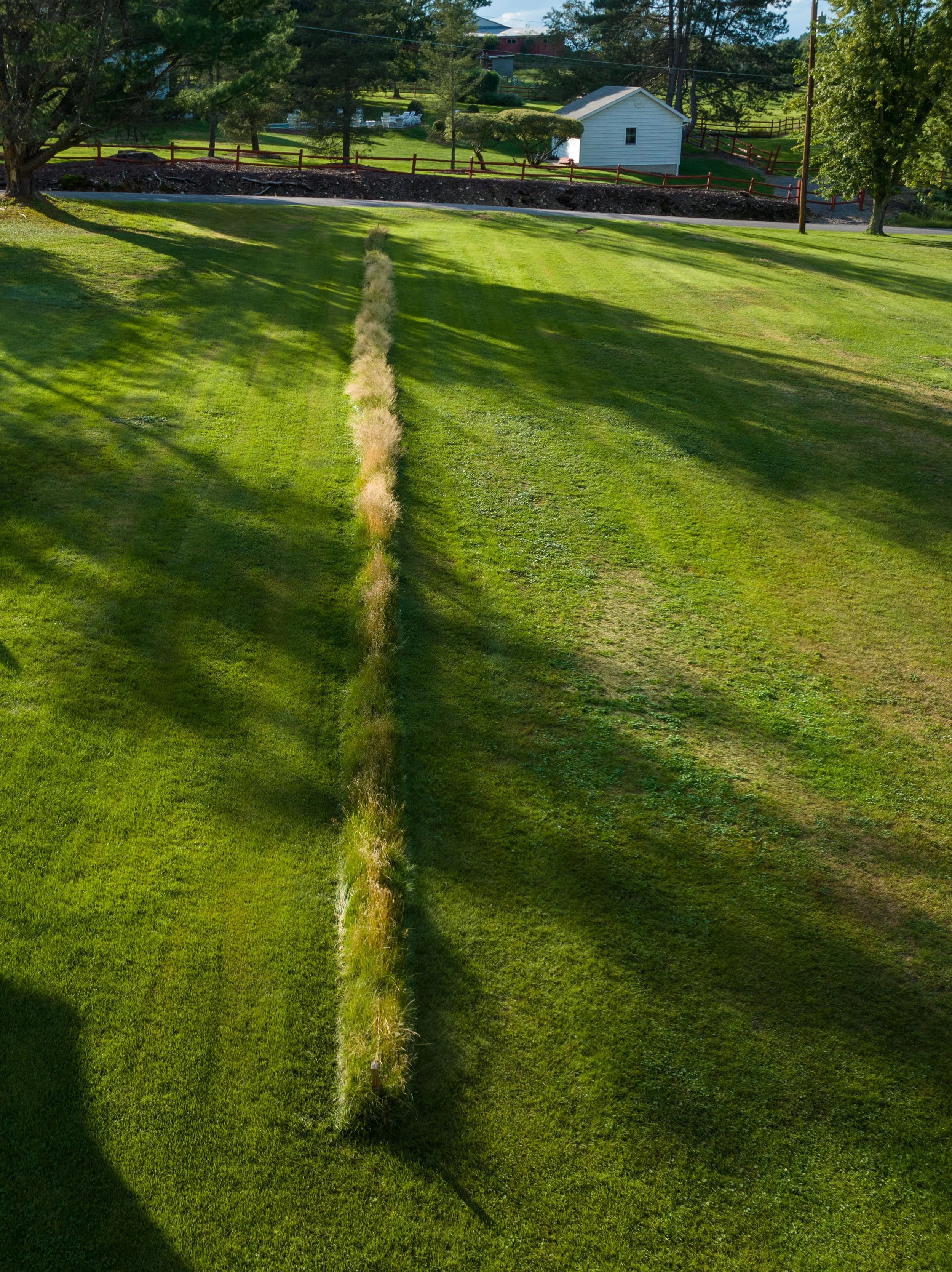
McDonnell’s engagement with natural materials and time was further shaped by his pilgrimage to Robert Smithson’s Spiral Jetty in Utah, an earthwork that records change through duration. That experience later revealed a subliminal connection to his ongoing project Grass Drawing, now in its third year. This work documents a single strip of grass left uncut within an otherwise manicured lawn, photographed as seasons pass to register weather, growth, and decay. In straightening Smithson’s spiral, Grass Drawing quietly chronicles entropy and persistence. The piece continues McDonnell’s continuing investigation into line-of-sight as it relates to positioning, point-of-view and alignment.
Additional influences-- Antonio Vivaldi’s Four Seasons, Barnett Newman’s Stations of the Cross, T. Crowley’s assertion that “every [abstract] painting is out there in the landscape”, Samuel Barber’s Adagio for Strings and David Whyte’s The Opening of Eyes (“fallen in love with solid ground”)-- continue to inform McDonnell’s evolving practice.
University of Vermont
Burlington, Vermont
1968-1972
BA, Studio and Art History Major, teaching assistant, graduated with Honors
Oberlin College
Oberlin, Ohio
1972-1974
Teaching Assistantship in graduate studies: painting, printmaking, art history
Saint Mark’s School
Southborough, Massachusetts
1975-1977
Art teacher
Mobius/Shelter
Martha’s Vineyard, Massachusetts and Waverly, Pennsylvania
1977-1985
Energy-efficiency design, consulting and construction
GPU, Inc
Reading, Pennsylvania
1986-2000
Energy conservation and load management
PPL, Inc.
Scranton, Pennsylvania
2000-2002
Commercial and industrial energy management
EXHIBITIONS
Huddersfeld Art Gallery
Huddersfeld, UK
1974
In-Security
Hudson Valley Museum of Contemporary Art
Peekskill, NY
February 7 — April 30, 2026
Truth Unveiled— Art as Reality, Illusion and Insight
Art League of Rhode Island
Pawtucket, RI
October 18 — December 6, 2025
Regeneration/Transformation
Imago Foundation for the Arts
Warren, RI
July 1 — August 23, 2025
Echoes of the Earth— Environmental Art
Bushwick Gallery
Brooklyn, NY
May 1 — May 8, 2025
Monochromica
Issue 006 — Brown art
Unapproached LLC
December 2025